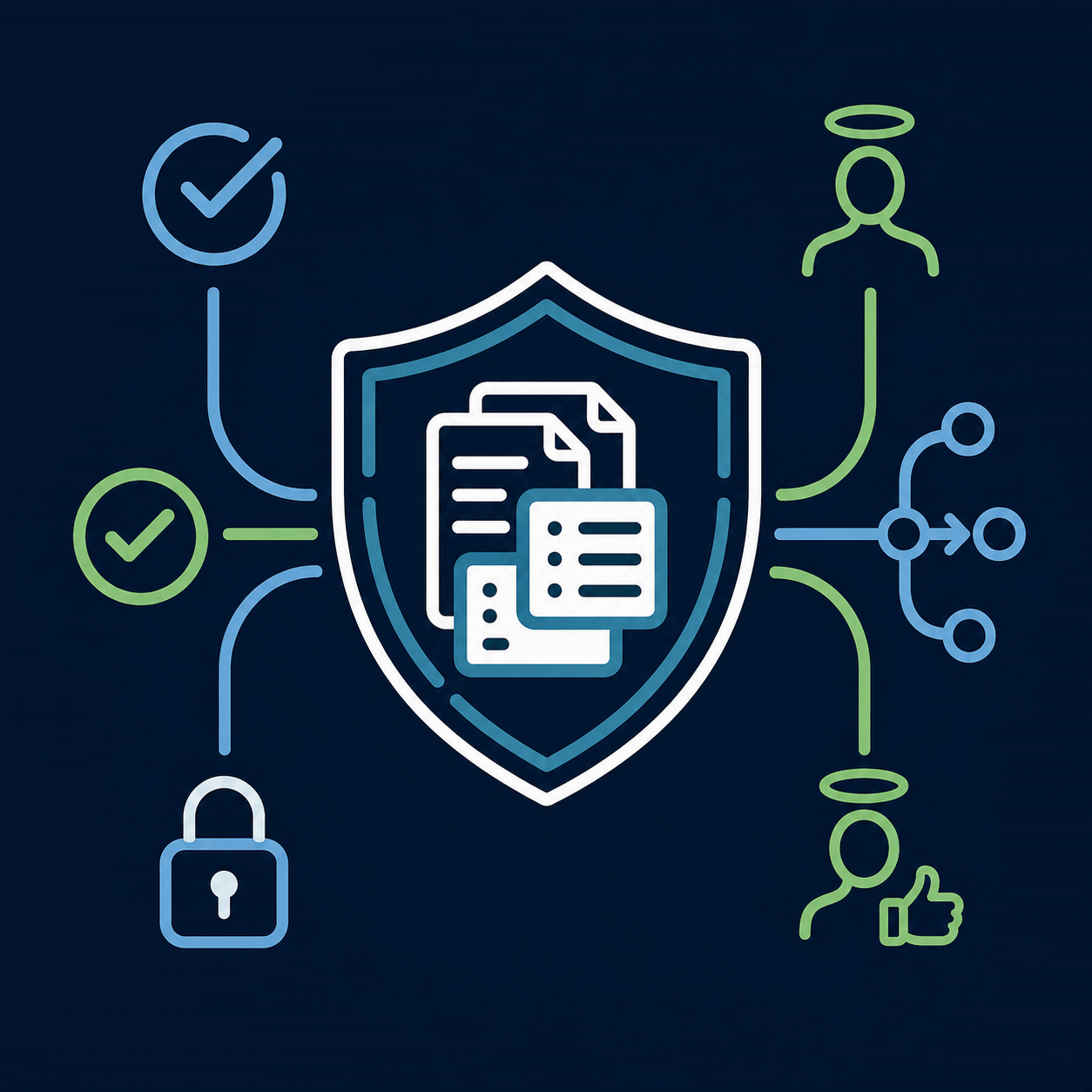
Legal AI security requires layered controls for confidentiality, sensitive-data handling, prompt injection, access, retention, integrations, supply-chain dependencies, logging, incident handling and human oversight.
Treat legal AI as an application-security and data-governance issue
Sensitive legal data, integrations and model behavior create risks beyond ordinary document software.
Prompt injection can alter intended behavior
OWASP identifies prompt injection as a major LLM application risk. Controls can include input separation, least privilege, tool restrictions, validation and security testing; no single prompt instruction should be treated as sufficient protection.
Sensitive information can leak through multiple paths
Review prompt/input data, model/provider handling, retrieval sources, logs, outputs, connectors and user sharing behavior.
Control agency and tool access
Agentic systems can call functions, retrieve data or execute actions. Restrict permissions, require approval for high-impact actions and log material activity.
Verify outputs before downstream use
Improper output handling can create security and operational problems when model output is passed directly to other systems. Validate, sanitize and review outputs according to context.
Include vendors and supply chain
Model providers, plugins, data sources, connectors and subprocessors should be part of security review.
Limitations and decision guidance
- OWASP risks are a security taxonomy, not legal conclusions.
- Security posture depends on configuration, deployment and integrations.
- No product should be described as secure based solely on certification or marketing.
Frequently asked questions
What are major legal AI security risks?
Sensitive-data disclosure, prompt injection, excessive agency, supply-chain dependencies, weak access controls and unsafe downstream handling.
Is a system prompt enough to protect confidential data?
No. Security requires layered technical and organizational controls.
Why does agentic AI need additional controls?
Because the system may be able to retrieve data, call tools or take actions, increasing the consequences of misuse or compromised instructions.
Related TechCorpLegal research
Continue through the most relevant connected research:
Decision framework and implementation research
Data Classification
A useful analysis of Legal AI Security: Enterprise Risks and Controls starts with data classification. The team should define what is being decided, who owns the decision, what evidence is available and which assumptions remain untested. This prevents a broad technology objective from becoming an implementation commitment before the underlying workflow, risk and operating constraints are understood. The output should be a documented decision record that can be revisited when the use case, vendor, model, data source or legal environment changes.
Access Control
The second control point is access control. Legal AI work often fails when a technical capability is evaluated in isolation from the surrounding process. The relevant question is not simply whether a model can perform a task, but whether the organization can govern the inputs, review the outputs, route exceptions and maintain accountability. Evidence should therefore include workflow observations, user requirements, security and data constraints, and the human steps that remain authoritative.
Vendor/Model Architecture
For vendor/model architecture, teams should distinguish a demonstration from production evidence. A successful demo may show that a task is technically possible, but production suitability depends on repeatability, error handling, integration, data treatment, access controls and the cost of supervision. A useful review records both positive evidence and failure conditions, because limitations often determine whether the use case should be deployed, narrowed, redesigned or deferred.
Logging
logging should also be evaluated across the full operating lifecycle. Initial configuration is only one stage. Organizations need a position on ownership after launch, change approval, documentation, user support, monitoring, incidents, vendor changes and retirement. This lifecycle view reduces the risk of creating a one-off pilot that cannot be governed once it becomes embedded in everyday legal work.
Retention And Deletion
A practical decision framework for retention and deletion should use explicit criteria rather than a single headline metric. Quality, risk, speed, user effort, control effectiveness and implementation burden may all matter, but their weight depends on the workflow. High-volume low-consequence tasks can justify a different review model from advice, filings, investigations or other work where an error can materially affect rights, obligations or strategy.
Incident Response
Finally, incident response needs an evidence and review loop. The organization should define what will be measured, how exceptions will be captured, who can pause or change the workflow and when the decision must be reconsidered. This turns Legal AI Security: Enterprise Risks and Controls from a static technology choice into a governed operating decision. The framework should remain proportionate: additional controls are valuable only when they address a real risk, dependency or accountability requirement.
Implementation note: The appropriate approach depends on the organization, workflow, data, risk tolerance and applicable law. A pilot or assessment should therefore be designed to produce evidence for a specific decision rather than to validate AI adoption in the abstract.
Evidence and sources
Sources are listed for transparency. Time-sensitive legal, regulatory and vendor statements must be rechecked immediately before publication or reliance.
- S02 — NIST: NIST AI RMF: Generative Artificial Intelligence Profile (NIST AI 600-1). Official/source page (accessed 2026-08-10)
- S14 — OWASP GenAI Security Project: OWASP Top 10 for LLMs and Generative AI Applications 2025. Official/source page (accessed 2026-08-10)
- S18 — OWASP GenAI Security Project: OWASP Top 10 for LLM Applications 2025. Official/source page (accessed 2026-08-10)
- S08 — Thomson Reuters Institute: AI implementation / success framework research. Official/source page (accessed 2026-08-10)
- S11 — Association of Corporate Counsel: Artificial Intelligence Toolkit for In-house Lawyers, Second Edition (2026). Official/source page (accessed 2026-08-10)
Related TechCorpLegal resources

PhD Data Scientist, Technology Law & Patent Attorney, and AI Educator with 20+ years advising global CEOs and CXOs on technology, business and legal innovation.
Need help applying this framework to your legal function?
Use the research framework to identify your current position, then discuss the workflow, governance, vendor or implementation questions that require deeper analysis.
Discuss This with TechCorpLegal