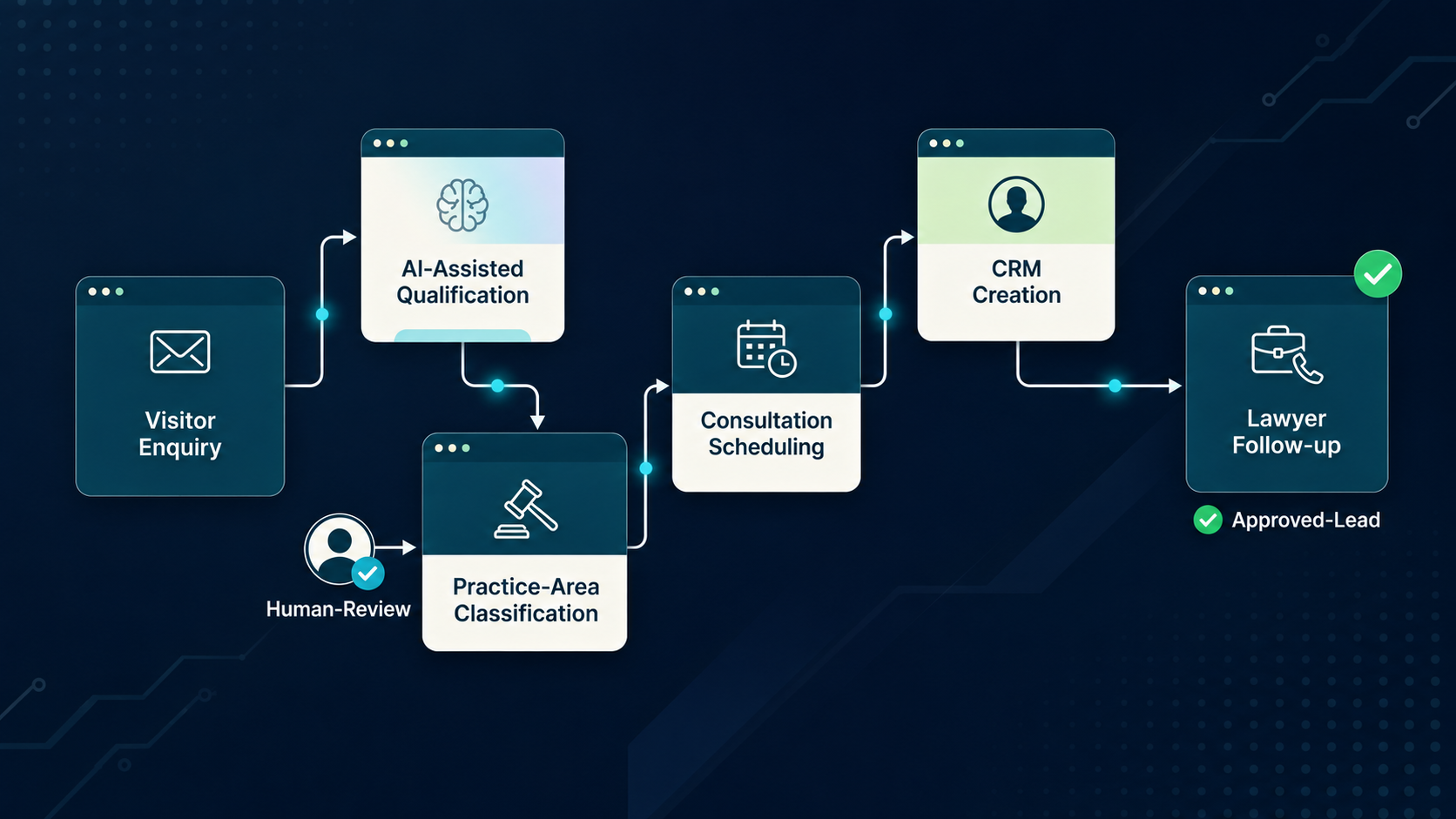
Legal AI implementation should begin with business problems and workflow readiness, then move through governance, use-case prioritization, vendor or build decisions, controlled pilots, integration, user adoption, measurement and evidence-based scaling.
Implementation is an operating-model problem
Legal AI implementation is not complete when a tool is licensed or a model is enabled. The implementation question is whether a defined legal workflow can use AI with appropriate data access, ownership, review, controls, user behavior and measurable outcomes. Treat business objectives, workflow design, governance, technology and adoption as one program.
Start with the workflow and baseline
Document the current process before selecting technology: inputs, decision points, handoffs, exceptions, cycle time, rework, escalation and the people who remain accountable. A baseline makes later claims about value testable rather than anecdotal.
Prioritize use cases by value, feasibility, risk and measurability
A strong first use case has a clear business problem, repeatable work, accessible inputs, an identifiable owner, manageable downside and a way to evaluate output. High-judgment or poorly defined workflows may require redesign before automation.
Govern before scale
Use a lifecycle governance model covering ownership, data, security, human oversight, testing, incident handling and change control. NIST AI RMF is voluntary and cross-sectoral; ISO/IEC 42001 is a management-system standard. Neither should be presented as automatic legal compliance.
Pilot with explicit success and stop criteria
A pilot should define approved users and data, baseline metrics, quality checks, escalation paths, user feedback and criteria for scaling, redesigning or stopping. A successful demo is not the same as a successful workflow.
Integrate adoption and measurement
Training, role clarity, policy, workflow fit and leadership sponsorship shape whether users adopt a system. Measure utilization together with throughput, cycle time, quality, rework, escalation, cost and risk indicators.
Implementation stage-gate matrix
| Gate | Evidence required | Decision |
|---|---|---|
| Readiness | Workflow, data, governance, owner, baseline | Proceed / remediate |
| Pilot | Scope, controls, approved users/data, success/stop criteria | Run / defer |
| Evaluation | Quality, risk, adoption, operating effect | Scale / redesign / stop |
| Scale | Integration, controls, support, monitoring, ownership | Expand / constrain |
Limitations and decision guidance
- There is no universal implementation sequence that fits every legal department.
- Implementation timelines and ROI depend on workflow, data, integrations, governance and adoption.
- Any jurisdiction-specific legal duty must be checked separately against current law.
Frequently asked questions
What is legal AI implementation?
The coordinated design and deployment of AI within legal workflows, including governance, data, technology, human review, adoption and measurement.
What should happen before a pilot?
Define the problem, baseline the workflow, confirm data/security constraints, assign ownership and set measurable success and stop criteria.
When should a pilot scale?
Only when evidence shows acceptable quality, risk, adoption and business value for the intended workflow.
Related TechCorpLegal research
Continue through the most relevant connected research:
- Legal AI Adoption in Enterprise Legal Teams
- Build vs Buy Legal AI | Enterprise Decision Framework
- Legal AI Business Case: How to Justify Investment
- Legal AI Change Management for Legal Departments
- Enterprise Legal AI Stack: Architecture and Controls
- Legal AI Metrics and KPIs for Enterprise Legal Teams
- Legal AI Pilot: How to Design and Evaluate One
- Legal AI Security: Enterprise Risks and Controls
- Legal AI Use Cases for Enterprise Legal Departments
- Legal AI Vendor Comparison Framework
Decision framework and implementation research
Workflow Selection
A useful analysis of Legal AI Implementation for Enterprise Legal Teams starts with workflow selection. The team should define what is being decided, who owns the decision, what evidence is available and which assumptions remain untested. This prevents a broad technology objective from becoming an implementation commitment before the underlying workflow, risk and operating constraints are understood. The output should be a documented decision record that can be revisited when the use case, vendor, model, data source or legal environment changes.
Pilot Design
The second control point is pilot design. Legal AI work often fails when a technical capability is evaluated in isolation from the surrounding process. The relevant question is not simply whether a model can perform a task, but whether the organization can govern the inputs, review the outputs, route exceptions and maintain accountability. Evidence should therefore include workflow observations, user requirements, security and data constraints, and the human steps that remain authoritative.
Governance Controls
For governance controls, teams should distinguish a demonstration from production evidence. A successful demo may show that a task is technically possible, but production suitability depends on repeatability, error handling, integration, data treatment, access controls and the cost of supervision. A useful review records both positive evidence and failure conditions, because limitations often determine whether the use case should be deployed, narrowed, redesigned or deferred.
Integration
integration should also be evaluated across the full operating lifecycle. Initial configuration is only one stage. Organizations need a position on ownership after launch, change approval, documentation, user support, monitoring, incidents, vendor changes and retirement. This lifecycle view reduces the risk of creating a one-off pilot that cannot be governed once it becomes embedded in everyday legal work.
Adoption
A practical decision framework for adoption should use explicit criteria rather than a single headline metric. Quality, risk, speed, user effort, control effectiveness and implementation burden may all matter, but their weight depends on the workflow. High-volume low-consequence tasks can justify a different review model from advice, filings, investigations or other work where an error can materially affect rights, obligations or strategy.
Measurement
Finally, measurement needs an evidence and review loop. The organization should define what will be measured, how exceptions will be captured, who can pause or change the workflow and when the decision must be reconsidered. This turns Legal AI Implementation for Enterprise Legal Teams from a static technology choice into a governed operating decision. The framework should remain proportionate: additional controls are valuable only when they address a real risk, dependency or accountability requirement.
Implementation note: The appropriate approach depends on the organization, workflow, data, risk tolerance and applicable law. A pilot or assessment should therefore be designed to produce evidence for a specific decision rather than to validate AI adoption in the abstract.
Evidence and sources
Sources are listed for transparency. Time-sensitive legal, regulatory and vendor statements must be rechecked immediately before publication or reliance.
- S01 — NIST: NIST Artificial Intelligence Risk Management Framework (AI RMF 1.0). Official/source page (accessed 2026-08-10)
- S02 — NIST: NIST AI RMF: Generative Artificial Intelligence Profile (NIST AI 600-1). Official/source page (accessed 2026-08-10)
- S03 — ISO: ISO/IEC 42001:2023 — Artificial intelligence management system. Official/source page (accessed 2026-08-10)
- S08 — Thomson Reuters Institute: AI implementation / success framework research. Official/source page (accessed 2026-08-10)
- S11 — Association of Corporate Counsel: Artificial Intelligence Toolkit for In-house Lawyers, Second Edition (2026). Official/source page (accessed 2026-08-10)
Related TechCorpLegal resources

PhD Data Scientist, Technology Law & Patent Attorney, and AI Educator with 20+ years advising global CEOs and CXOs on technology, business and legal innovation.
Need to turn this into an organization-specific decision?
Use the research framework to identify your current position, then discuss the workflow, governance, vendor or implementation questions that require deeper analysis.
Discuss Your Legal AI ImplementationFor organizations that need external support across readiness, governance, vendor decisions and rollout, see our legal AI consultant.
For teams moving from pilots into controlled deployment, see Legal AI Implementation Consulting: From Pilot to Production.
For multi-step AI agents and the controls they require, see Agentic AI for Legal Departments: Use Cases, Governance and Implementation.
For requirements-led procurement and vendor evaluation, see Legal AI Vendor Selection Consulting.
Explore Legal AI Jobs & Careers — roles, skills and portfolio projects based on current hiring signals.
For a related law-firm decision, see Claude for lawyers: training and supervision. This focused resource complements the present page rather than replacing its research.
For a related law-firm decision, see Law-firm knowledge and precedent AI systems. This focused resource complements the present page rather than replacing its research.