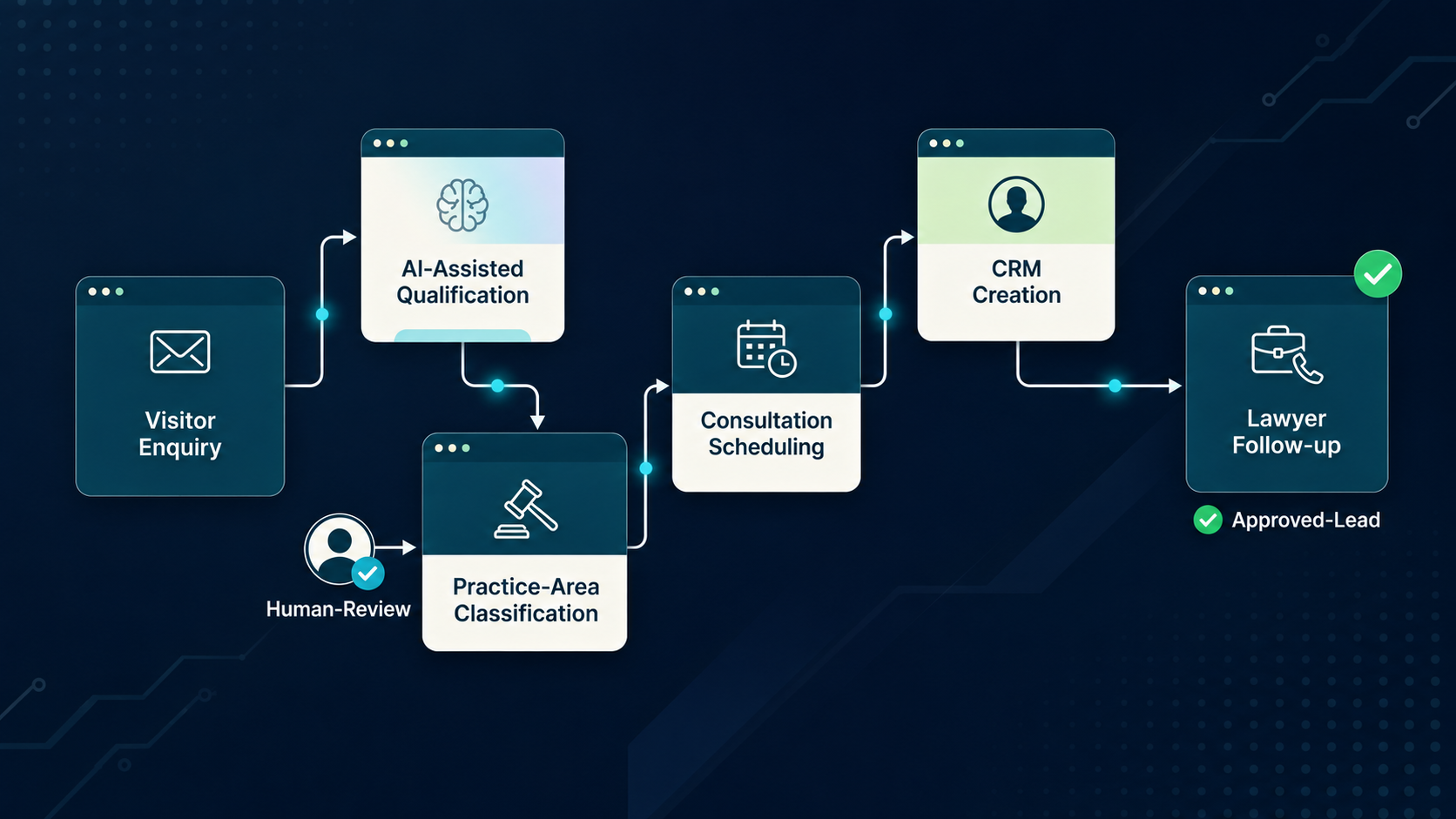
Legal AI implementation consulting helps a legal department turn an AI objective into a production-ready operating workflow. The work should connect readiness, process design, data and security, governance, vendor or architecture choices, pilot evidence, adoption and measurement. Buying software or completing a demonstration is not the same as implementing AI.
Implementation scope and operating model
Implementation begins by defining the operating problem rather than the product. A legal team may be trying to shorten contract review, improve matter intake, retrieve internal knowledge, support research, standardize recurring analysis or manage high-volume administrative work. Each objective creates different requirements for users, data, review, integrations and accountability. The implementation consultant should therefore document the current state, the target workflow, owners, dependencies and evidence needed for a later deployment decision.
The operating model should also distinguish assistance from execution. Some tasks may justify drafting or summarization support with mandatory human review, while others may involve routing, classification or rules-based automation. Higher-consequence work generally needs stronger approval, escalation and recordkeeping. This design work prevents an attractive product demonstration from becoming the de facto architecture without a clear decision about how the system will actually be used.
Readiness and workflow selection
Readiness is workflow-specific. A department can be ready to pilot AI in one process and unready in another. Useful readiness questions cover process stability, quality of source material, data access, integration dependencies, security constraints, user capacity, review burden and whether a baseline exists. Workflows with clear triggers, repeatable inputs and observable outputs are easier to evaluate than ambiguous processes whose success cannot be measured.
Thomson Reuters' in-house readiness guidance emphasizes implementation, training and integration as adoption accelerates. The practical implication is that readiness should be treated as a gate, not a marketing label. A consultant can help rank candidate workflows by business value, feasibility, consequence of error and supervision needs, then select a pilot that can produce credible evidence rather than merely generate enthusiasm.
Governance, security and data
Governance belongs inside implementation. The project should identify who approves the use case, what data can enter the system, who can access outputs, when human approval is required, how incidents are escalated and who can pause the workflow. Security review should consider the actual deployment architecture, including identity and permissions, retention, integrations, subcontractors, logging and how the vendor handles customer data.
NIST's AI Risk Management Framework is voluntary and cross-sectoral, but it provides a useful vocabulary for managing AI risk through governance, mapping, measurement and management. A legal department can use that kind of structure without treating it as a legal safe harbor. Where a workflow raises jurisdiction-specific confidentiality, privacy, professional-responsibility or regulated-data issues, current legal advice should be layered into the implementation rather than inferred from a general framework.
Vendor/build decision
A build-versus-buy decision should follow requirements. Commercial platforms may offer faster deployment, support and established integrations, while internal or hybrid approaches may provide greater control over workflow logic, data handling or orchestration. The relevant comparison is not which option appears most advanced; it is which option best fits the defined legal workflow, governance model, security requirements, technical environment and operating capacity.
Evaluation should therefore include implementation burden as well as functionality. Contract terms, data handling, integration work, configuration, change management, monitoring, portability and vendor dependence can materially affect the decision. A consultant should make assumptions and tradeoffs explicit so that procurement, legal, security and technology stakeholders are evaluating the same decision rather than separate feature lists.
Pilot and production criteria
A pilot should answer a specific question: is this workflow suitable for controlled production under the defined conditions? Test cases should represent routine work, difficult work and known failure modes. Reviewers should record quality observations, correction effort, exceptions, data issues and control failures. If the tool changes during the pilot, the team should record that as part of the evidence rather than silently treating the test as static.
Production readiness is not a single accuracy threshold. The team should also know whether users can operate the workflow consistently, whether exceptions are handled, whether controls are observable, whether integrations are reliable and whether the review burden is proportionate to the value created. A pilot is successful when it supports a defensible decision—even if the decision is to redesign or stop.
Change management and adoption
Legal AI adoption is an operating change. Users need to understand when the workflow should be used, what the system is allowed to do, what they remain responsible for checking and how to escalate uncertain cases. Training should be tied to the actual workflow and policy rather than limited to product features. Managers also need a feedback route for weak outputs, missing data, friction and unintended behavior.
Adoption metrics should distinguish access, activity and meaningful use. A licensed user is not evidence of workflow value, and high usage is not automatically evidence of quality. The implementation plan should identify owners for training, support, governance and workflow updates so the capability can continue after the initial consulting or pilot phase.
Measurement and review
Measurement starts with a baseline. Depending on the workflow, useful evidence can include turnaround time, review effort, exception rate, rework, adoption, escalation frequency, user feedback and control effectiveness. Financial measures may be useful, but they should be interpreted with implementation, supervision and integration costs rather than converted into a universal savings claim.
Thomson Reuters has reported a substantial gap between AI adoption and formal ROI measurement in corporate legal departments. That makes measurement architecture a practical implementation requirement. The team should decide in advance which evidence will trigger scale, redesign or stop, who reviews it and when the workflow will be reassessed after deployment.
Limitations and specialist legal advice
Implementation consulting can structure technology, workflow, governance and operating decisions, but it does not replace legal advice on a specific obligation, filing, dispute or regulated activity. Product behavior and terms change, and enterprise architectures differ. Material assumptions about privacy, privilege, confidentiality, data residency, professional responsibility or regulatory restrictions should be checked against current facts and applicable law.
The implementation plan should therefore preserve unresolved dependencies rather than hide them. A clear record of assumptions, decisions, owners, evidence and review dates is more valuable than a claim that the project is 'fully compliant' or complete. Controlled implementation means knowing what is proven, what remains uncertain and who owns the next decision.
Frequently asked questions
What does a legal AI implementation consultant do?
A legal AI implementation consultant helps define the workflow, assess readiness, establish controls, evaluate architecture or vendors, design pilots, support adoption and create a measurement and review model.
How long should a legal AI pilot run?
There is no universal pilot duration. The pilot should run long enough to test representative work, difficult cases, failure modes, user behavior and controls against pre-agreed decision criteria.
What should be tested before production deployment?
Production testing should cover workflow quality, exceptions, human review, data handling, security, integrations, logging, user adoption and the evidence needed for a scale, redesign or stop decision.
How should legal AI success be measured?
Measure against a baseline using workflow-appropriate evidence such as review effort, turnaround, rework, exceptions, adoption, escalation and control effectiveness rather than relying on a single ROI percentage.
What governance is required during implementation?
Governance should define ownership, permitted uses, data rules, human approvals, vendor controls, incident escalation, monitoring and review before the workflow is scaled.
Evidence and sources
- Thomson Reuters — What legal professionals say about the role of AI and law in 2026
- Thomson Reuters — The reality check every corporate legal department needs to hear about AI
- Thomson Reuters Institute — Is your in-house legal department ready for AI?
- CLOC — 2026 State of the Industry Report findings
- NIST — AI Risk Management Framework (AI RMF 1.0)
Related TechCorpLegal resources
About the research lead

Dr. Rahul Dev
Dr. Rahul Dev works across data science, patents, technology law, AI, legal workflows and business strategy. TechCorpLegal uses that interdisciplinary perspective to connect legal intelligence with governance, technology-selection and implementation decisions.
Career and capability research: Legal AI Engineer — skills, projects and current hiring signals.
Career and capability research: Legal AI Product Specialist — skills, projects and current hiring signals.
Career and capability research: Forward-Deployed Legal Engineer — skills, projects and current hiring signals.
Career and capability research: Legal AI Implementation Consultant — skills, projects and current hiring signals.
Plan Your Legal AI Implementation
Start with the jurisdiction, workflow or business objective, current stage, systems or vendors involved, and the decision that needs to be made.
Information notice: This material is provided for information and research purposes only and does not constitute legal advice. Legal, regulatory, confidentiality, professional-responsibility and security requirements vary by jurisdiction, facts, systems and implementation context.