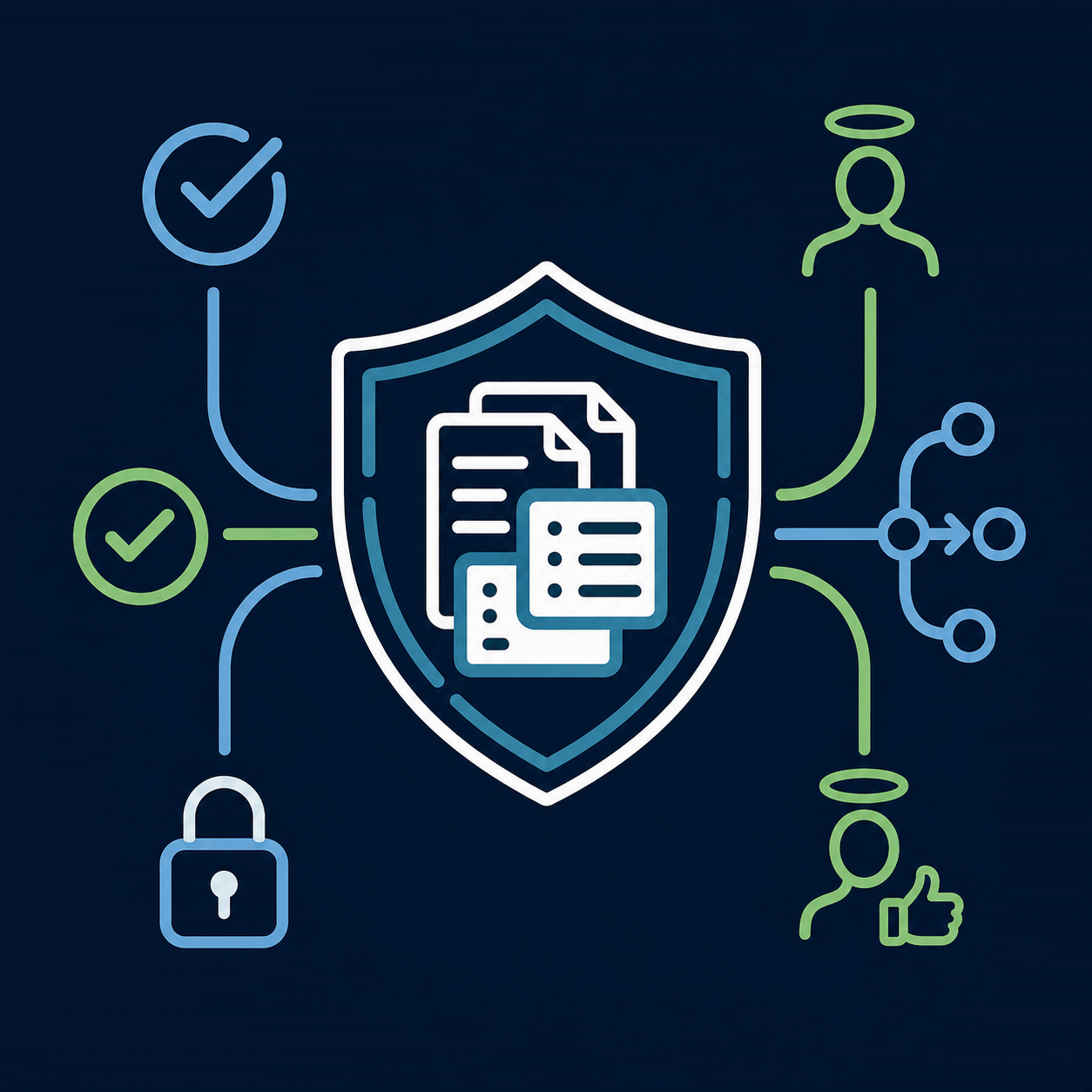
AI governance for legal departments is the operating model that determines who can approve AI use, what data and tools are allowed, when human review is mandatory, how vendors are controlled, how incidents are handled and how deployed workflows are monitored and reviewed. A policy is one artifact inside that broader system.
Governance operating model
A legal AI governance model should connect policy with operational decisions. It identifies the governing body or owner, how use cases are proposed and classified, what approvals are required, how exceptions are handled and how evidence is retained. The model should be understandable to legal professionals, technology teams and business stakeholders rather than existing only as an abstract set of principles.
NIST's AI Risk Management Framework is voluntary and cross-sectoral, but its Govern, Map, Measure and Manage functions provide a useful structure for thinking about risk. A legal department can adapt such guidance to its own policies, legal obligations and professional responsibilities without presenting the framework as law or certification.
Ownership and accountability
Governance fails when responsibility is distributed so widely that no one owns the decision. The department should identify accountable leaders for policy, use-case approval, technology, data, security, vendor management and incident handling. For individual workflows, there should also be an operational owner who can pause or change the process when evidence changes.
Accountability should follow authority. A reviewer cannot meaningfully own a control if they lack access to logs, cannot change the workflow or cannot escalate a vendor issue. Governance design should therefore connect responsibilities with permissions and decision rights.
Permitted and prohibited uses
A policy should translate risk appetite into concrete permitted, restricted and prohibited uses. Low-consequence drafting support may be allowed under defined conditions, while external communications, unsupervised legal conclusions or autonomous actions may require stricter approval or prohibition. The categories should be tied to consequence and control rather than to vague labels such as 'high risk' without explanation.
The governance process should also handle new uses. Employees will discover capabilities that were not anticipated when the policy was written. A lightweight approval route allows experimentation to be evaluated without forcing users either to ignore policy or abandon potentially valuable ideas.
Data, confidentiality and security
Legal AI governance needs rules for data access, confidentiality, retention, training, sharing and system integration. These rules should reflect both the organization's security architecture and the legal context of the information. A tool may be enterprise-approved yet unsuitable for a particular workflow because the data or external action creates additional obligations.
The department should identify authoritative repositories and access boundaries. Retrieval or agentic systems can magnify existing permission problems if they can surface information to users who could not easily find it manually. Governance should therefore include identity, least-privilege access and logging where relevant.
Vendor governance
Vendor approval should cover more than the initial security questionnaire. The department should know which use cases are approved, what configuration was evaluated, which data flows exist, how model or product changes are communicated and who reviews material changes. Contract terms, subprocessors, retention, support and incident processes may also matter depending on the deployment.
Vendor governance should continue after purchase. A platform can add features, change models or expand integrations. Periodic review helps determine whether the original assumptions remain valid and whether new functionality requires another use-case assessment.
Human oversight and approvals
Human oversight should identify who reviews what, when and against which criteria. A generic instruction to 'keep a human in the loop' can become ineffective if reviewers are overloaded or unclear about responsibility. The workflow should place approvals where they materially reduce risk and give reviewers enough context to make the decision.
For agentic systems, approval may need to occur before external actions, tool invocation or changes to systems of record. The level of control should reflect the consequence and reversibility of the action. Human oversight is therefore a design choice, not a universal checkbox.
Monitoring, incidents and escalation
Governance continues after deployment through monitoring and incident handling. Teams should identify relevant signals such as repeated exceptions, policy violations, unexpected tool behavior, security events, material quality failures or changes in vendor functionality. A clear escalation route helps the organization respond without improvising during an incident.
Deloitte's enterprise research has reported that mature governance for agentic AI remains limited even as adoption scales. That figure is not specific to legal departments, but it illustrates why action-taking systems deserve explicit oversight. Legal departments should assess their own maturity rather than infer readiness from market adoption.
Documentation and review cadence
Documentation should preserve the use-case purpose, data sources, workflow, approvals, controls, vendor assumptions, test evidence, incidents and review dates. The objective is not to create paperwork for its own sake; it is to retain enough context to explain why the workflow was approved and what would trigger reconsideration.
Governance should be reviewed after material changes and on a regular cadence. Policies, systems, vendors and law evolve. A governance model that cannot absorb change will either become obsolete or encourage workarounds. The department should therefore define how updates are proposed, approved and communicated.
Governance readiness checklist
Before scaling a governed legal AI workflow, the department should be able to identify the accountable owner, approved purpose, data sources, permitted users, human-review points, vendor assumptions, incident route and review date. It should also know who has authority to change or pause the workflow. Missing answers indicate a governance dependency that should be resolved rather than hidden behind a general policy statement.
Governance should also account for interaction between controls. A strong data rule is less effective if permissions are broad; a human approval is weaker if the reviewer cannot inspect sources; a vendor diligence process loses value if material product changes are not monitored. Testing the control system as a whole helps the department identify gaps that individual checklists may miss. The objective is not maximal bureaucracy but enough operating evidence to know how the workflow is controlled and how the organization will respond when assumptions change.
Frequently asked questions
Who should own AI governance in a legal department?
Ownership should sit with accountable legal leadership, supported by legal operations, technology, security, privacy, procurement and other functions relevant to the use case.
What legal AI uses should require approval?
Approval should increase with consequence, data sensitivity, autonomy, external impact and uncertainty. The policy should define categories rather than relying on ad hoc judgment.
What data rules should apply to legal AI?
Data rules should cover permitted repositories, confidential information, retention, training, access, sharing, integrations and any jurisdiction-specific restrictions.
How should legal AI vendors be governed?
Govern vendors through requirements, due diligence, approved use cases, contract terms, configuration review, change monitoring, incident processes and periodic reassessment.
What monitoring and incident controls are needed?
Monitoring should cover quality signals, exceptions, policy violations, product changes and incidents, with named owners, escalation paths and the ability to pause affected workflows.
Evidence and sources
Related TechCorpLegal resources
About the research lead

Dr. Rahul Dev
Dr. Rahul Dev works across data science, patents, technology law, AI, legal workflows and business strategy. TechCorpLegal uses that interdisciplinary perspective to connect legal intelligence with governance, technology-selection and implementation decisions.
Career and capability research: AI Governance Specialist — skills, projects and current hiring signals.
Discuss AI Governance
Start with the jurisdiction, workflow or business objective, current stage, systems or vendors involved, and the decision that needs to be made.
Information notice: This material is provided for information and research purposes only and does not constitute legal advice. Legal, regulatory, confidentiality, professional-responsibility and security requirements vary by jurisdiction, facts, systems and implementation context.