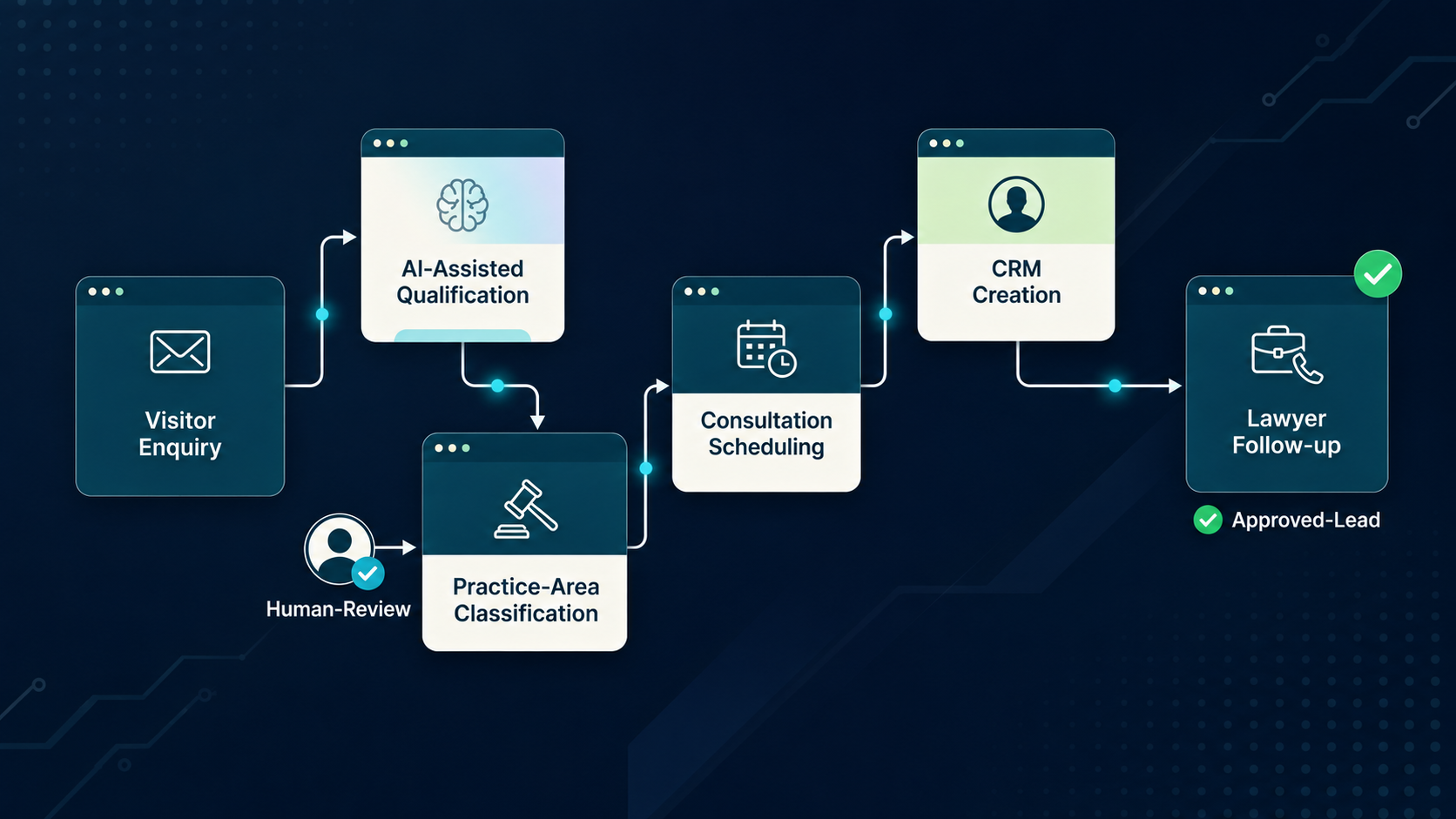
Legal department automation is the structured redesign of repeatable legal and operational work so that rules, conventional software and AI handle suitable steps while people retain control over judgment, exceptions and high-consequence decisions. The department should decide what to automate before deciding which automation technology to buy.
Department-wide automation portfolio
A legal department should view automation as a portfolio rather than a collection of one-off scripts or vendor features. The portfolio may include intake, routing, approvals, contract administration, recurring research, reporting, matter management, knowledge workflows and compliance support. Each candidate should be ranked by business value, process stability, volume, data quality, consequence of error and the cost of supervision.
CLOC's 2026 reporting describes increasing legal demand in areas such as regulatory compliance and cybersecurity while budget and headcount growth remain more constrained. That pressure creates a strong reason to improve operations, but it does not justify automating indiscriminately. A portfolio approach helps leadership place resources where workflow redesign can be tested and measured.
Candidate workflows
Good candidates usually have a clear trigger, repeatable inputs, known decision rules or patterns and observable outputs. Intake routing, status updates, document classification, recurring reporting and structured first-pass review may fit this profile better than novel strategic advice. The department should still examine exceptions because a process that looks routine may contain hidden judgment at key points.
Suitability should be evaluated with the people who perform the work. They know where source material is unreliable, where unofficial workarounds exist and where a seemingly simple decision depends on context. Mapping these realities before automation reduces the risk of designing a technically clean workflow that fails in daily use.
Process redesign before automation
Automation should not preserve unnecessary steps. Before assigning work to software, ask whether approvals can be simplified, duplicate data entry removed, templates standardized, ownership clarified or low-value handoffs eliminated. This can reduce the number of automated components and make the remaining workflow easier to govern.
The redesigned workflow should show its trigger, inputs, decision points, system actions, human checkpoints, exception path, output and record. That map becomes a control artifact as well as a technical specification. It helps legal, operations, IT and vendors discuss the same process instead of interpreting the word 'automation' differently.
Rules automation versus AI
Not every automated legal workflow needs AI. Deterministic rules are preferable where conditions are stable and explicit because they are easier to test and audit. AI may add value where the workflow involves language, classification, retrieval or probabilistic interpretation. Hybrid designs can use rules for routing and approvals while AI supports content-oriented steps.
The decision should consider error consequence and explainability needs. If the organization can express a decision reliably through fixed logic, adding AI may create unnecessary variability. If AI is used, the workflow should make clear which steps are probabilistic and which downstream actions require human confirmation or additional controls.
Human checkpoints and exception handling
Human review should be placed where it changes risk, not scattered as a generic requirement. A checkpoint may confirm source authority, approve a contract change, validate a classification, review an exception or authorize an external action. The reviewer should know what evidence to inspect and what conditions require escalation.
Exception handling is equally important. Inputs may be missing, conflicts may arise, a matter may fall outside policy or a model may produce uncertain output. The automated path should stop safely and route the case rather than force it through a normal branch. These exception rules preserve resilience and prevent automation from hiding uncertainty.
Governance and auditability
A department-wide automation program needs ownership, version control and records. Teams should know who can change workflow logic, how changes are tested, which systems hold authoritative data, how user access is controlled and what logs are retained. For AI-enabled steps, model or vendor changes may also require review because behavior can shift without a visible workflow redesign.
NIST AI RMF can provide a voluntary risk-management vocabulary for AI-enabled components, while internal policies and applicable law determine the organization's actual obligations. The goal is not to label every workflow compliant; it is to make ownership, assumptions, controls and evidence visible enough to support responsible operation.
Operational metrics
Metrics should be chosen before automation so there is a baseline. Depending on the workflow, the department may track turnaround, queue size, manual touches, review effort, exception rates, rework, escalation, user satisfaction or control failures. Volume processed is useful but should not be confused with improved legal service.
Benefits should be treated as hypotheses. A faster process may increase review burden, an AI classification may create rework, or a new portal may shift work rather than remove it. Measurement allows the department to discover those tradeoffs and decide whether to refine, expand or retire the automated workflow.
Limitations
Automation is not appropriate for every legal activity. Novel strategic questions, high-consequence judgment, uncertain source material and matters requiring nuanced client or stakeholder interaction may need substantial human control. Even suitable automation depends on data quality, integration, policy and user behavior.
The department should also avoid treating a workflow design as permanent. Business structures, legal requirements, vendors and internal systems change. Owners should review the workflow periodically and after material incidents or system changes. Automation is an operating capability that needs governance and maintenance, not a one-time deployment.
Automation decision checklist
Before approving a legal automation initiative, the department should confirm that the current process is understood, the intended outcome is measurable and the exception path is visible. It should know which steps are truly repetitive, which depend on professional judgment, which systems hold authoritative data and how users will correct an automated result. These questions help distinguish a workflow that is ready for redesign from one that first needs standardization, policy clarification or better data.
The portfolio owner should also check whether several automation projects are solving the same underlying problem in different ways. Duplicate tools, overlapping intake routes or inconsistent taxonomies can create more operational complexity even when each project appears useful in isolation. Department-wide automation should therefore include architecture and governance decisions about shared data, common controls and ownership so local workflow improvements do not fragment the legal operating model.
Frequently asked questions
Which legal workflows are easiest to automate?
Repeatable workflows with clear triggers, structured inputs and observable outputs are usually easier to automate, but risk, data and exception patterns still matter.
What legal work should not be automated?
Novel strategic advice, high-consequence judgment and work with substantial uncertainty generally require stronger human control even where automation assists.
How should legal automation opportunities be prioritized?
Score candidate workflows by value, volume, process stability, data readiness, risk, exceptions, integration effort and supervision burden.
How do AI and rules-based automation differ?
Rules-based automation follows explicit logic; AI is probabilistic and is more suited to language, classification, retrieval or pattern interpretation when controls are appropriate.
How should automation outcomes be measured?
Track workflow-specific baselines such as turnaround, manual touches, review effort, exceptions, rework, escalation and control effectiveness.
Evidence and sources
Related TechCorpLegal resources
About the research lead

Dr. Rahul Dev
Dr. Rahul Dev works across data science, patents, technology law, AI, legal workflows and business strategy. TechCorpLegal uses that interdisciplinary perspective to connect legal intelligence with governance, technology-selection and implementation decisions.
Career and capability research: Legal Operations AI Manager — skills, projects and current hiring signals.
Discuss Legal Department Automation
Start with the jurisdiction, workflow or business objective, current stage, systems or vendors involved, and the decision that needs to be made.
Information notice: This material is provided for information and research purposes only and does not constitute legal advice. Legal, regulatory, confidentiality, professional-responsibility and security requirements vary by jurisdiction, facts, systems and implementation context.